If you've spent any time in mechanical keyboard communities, you've probably heard someone describe a switch as "creamy." It's one of those words that gets thrown around constantly — but what does it actually mean, and why does it matter when you're choosing keyboard switches for your next build?
This post breaks down what creamy keyboard switches are, what sets the most popular options apart, and which ones are worth your money. At the end, we'll pair our top pick with a couple of ortholinear keyboards that let that creaminess shine.
What Are Creamy Keyboard Switches?
The word "creamy" refers to a combination of tactile smoothness and a deep, muted sound profile. A creamy switch feels buttery under your fingers — linear travel with minimal scratchiness — and produces a low-pitched, almost muffled thock rather than a higher-pitched clack.
Two things usually create this character:
Milky or semi-opaque housing. Many creamy switches use a nylon or PA66 housing that's white or translucent (often called "milky"). The material itself is softer-sounding than the fully transparent polycarbonate housings used on RGB-focused switches. It absorbs and diffuses sound rather than amplifying it.
POM or lubed stems. POM (polyoxymethylene) is a naturally self-lubricating plastic that produces very little friction. Switches that use POM stems — or that come factory pre-lubed — tend to have that unmistakable smooth, quiet glide that people call creamy. This is why lubing linear keyboard switches is one of the first modifications most enthusiasts make: it turns a decent switch into a creamy one.
Creamy switches are almost always linear, though there are a few tactile and even clicky variants that borrow the housing material for its sound properties.
The Best Creamy Keyboard Switches Compared
Here's a look at the most popular options on the market right now.
Gateron Milky Yellow Pro V2

The Gateron Milky Yellow Pro V2 is the switch that introduced a lot of people to the creamy sound profile. Gateron's Milky series uses a white nylon top and bottom housing — the "milky" in the name — which is responsible for that warm, thocky character people chase.
The Pro V2 comes factory pre-lubed, with 50gf actuation and a smooth 5-pin PCB-mount design. Compared to the original Milky Yellow, the Pro V2 has tighter tolerances, less stem wobble, and a more consistent feel from switch to switch. It's fast enough for gaming and smooth enough for long typing sessions.
Sound: Deep, muted thock
Actuation: 50gf
Housing: Milky nylon top and bottom
Stem: Yellow POM
Pre-lubed: Yes
Akko V3 Creamy Yellow Pro

The Akko V3 Creamy Yellow Pro is Akko's dedicated entry into the creamy switch category. At 50gf actuation with a dustproof stem design, it's built with longevity in mind — a useful feature if you're typing on the same board for years.
The Creamy Yellow Pro uses a PC/PA66 housing combination that keeps the sound profile warm without sacrificing RGB visibility entirely. It's a 5-pin switch, so it works with any standard hot-swap PCB. Compared to the Gateron Milky Yellow, the Akko tends to have a slightly more tactile-feeling bottom-out — not a bump, just a firmer landing — which some typists actually prefer.
Sound: Warm, medium-pitched thock
Actuation: 50gf
Housing: PC/PA66 combination
Stem: Dustproof design
Pre-lubed: Yes
EPOMAKER Creamy Jade

The EPOMAKER Creamy Jade is the lightest switch in this comparison at 45gf actuation. If you want that creamy feel without the resistance of a heavier spring, this is worth a close look. It uses a PC/PA66 housing with a POK (polyoxyketon) stem — a high-performance engineering plastic that's smoother than standard POM and more resilient over time.
The Creamy Jade has a slightly brighter sound signature than the Gateron Milky Yellow or Akko Creamy Yellow Pro, landing somewhere between "thock" and "clack." The lighter spring also means it sounds a bit airier than the other switches here. For people who like a light linear but still want that smooth, cushioned feel, the Creamy Jade is a compelling option.
Sound: Medium, slightly brighter thock
Actuation: 45gf
Housing: PC/PA66
Stem: POK
Pre-lubed: Yes
Akko CS Cream Yellow
The Akko CS Cream Yellow is one of Akko's original creamy offerings and sits at an incredibly light 35gf actuation — the lightest in this roundup. If you have a feather-light touch or type for extended hours and want to minimize finger fatigue, the Cream Yellow is worth considering.
The sound is softer and more dampened than the switches above, and the light actuation means it can feel almost effortless at times. The trade-off is that bottoming out is very easy, which can cause more typos until you adjust.
Sound: Soft, dampened
Actuation: 35gf
Housing: Nylon
Pre-lubed: Yes
Akko CS Cream Black
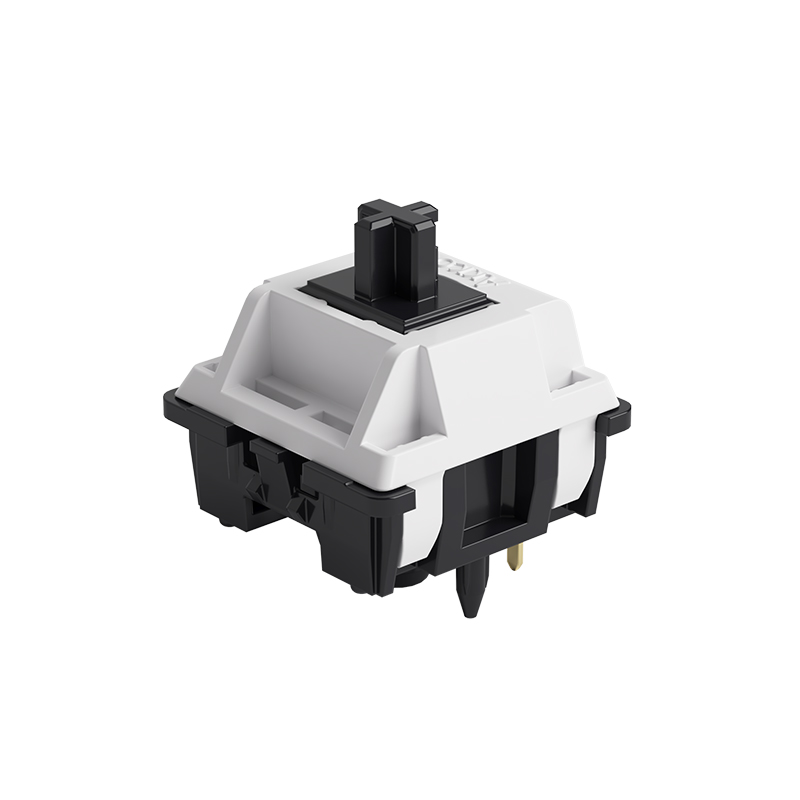
On the opposite end of the spectrum, the Akko CS Cream Black is a heavier linear with a firmer spring. It uses the same creamy nylon housing as the Cream Yellow but with a stiffer actuation that prevents accidental keypresses. Heavy typists or gamers who prefer resistance will find this one satisfying.
The heavier spring also contributes to a slightly deeper, more substantial sound — closer to a true thock than the lighter variants.
Akko CS Cream Blue
The Akko CS Cream Blue is the odd one out: a clicky switch in a sea of linears. It borrows the creamy housing for its sound-dampening properties, resulting in a clicky switch that's noticeably quieter than something like a Cherry MX Blue. If you like tactile feedback with an audible click but don't want to disturb everyone in the room, the Cream Blue splits the difference reasonably well.
Key Differences at a Glance
| Switch | Actuation | Type | Pre-lubed | Sound Profile |
|---|---|---|---|---|
| Gateron Milky Yellow Pro V2 | 50gf | Linear | Yes | Deep, warm thock |
| Akko V3 Creamy Yellow Pro | 50gf | Linear | Yes | Warm, medium thock |
| EPOMAKER Creamy Jade | 45gf | Linear | Yes | Medium, slightly bright |
| Akko CS Cream Yellow | 35gf | Linear | Yes | Soft, dampened |
| Akko CS Cream Black | ~65gf | Linear | Yes | Deep, heavy thock |
| Akko CS Cream Blue | ~45gf | Clicky | Yes | Quieter click |
Our Recommendation: Gateron Milky Yellow Pro V2
All of these switches are genuinely good — that's not a hedge. Akko's lineup in particular offers impressive value at every price point, and the EPOMAKER Creamy Jade is worth trying if you want something a little different.
That said, the Gateron Milky Yellow Pro V2 is our top pick. It's the switch that defined what "creamy" means for most of the keyboard community, and the Pro V2 update addressed the few complaints people had about the original. The combination of 50gf actuation, factory lube, tight tolerances, and that classic milky nylon housing gives you an immediately recognizable feel and sound that's hard to beat — especially at the price point.
It works out of the box, pairs beautifully with PBT keycaps, and is a strong choice whether you're building your first mechanical keyboard or your fifteenth.
The Best Ortholinear Keyboards to Pair With Creamy Switches
Creamy switches really come alive in ortholinear keyboard builds. The compact, minimalist form factor of an ortholinear keyboard keeps the acoustic chamber tight and focused, and the even grid layout means every keypress sounds consistent. If you're buying switches for a new build, here are two ortholinear options worth pairing them with.
Chosfox x Masro Geonix Rev.2
The Chosfox x Masro Geonix Rev.2 is our current top pick for a creamy-switch home. It's a 40% low-profile ortholinear board with CNC aluminum construction, tri-mode wireless, and hot-swap sockets for Choc v2 switches. The dense aluminum case is exactly the kind of resonant chamber that makes creamy linears sing — and since Choc v2 sockets accept the right switches without adapters, you can drop in a creamy-feeling low-profile switch and have a fully-built quiet board in under thirty minutes.
The Geonix is also the closest modern successor to the Planck now that the OLKB Planck is hard to source post-Drop. If you came to this post originally looking for a Planck pairing, the Geonix is the equivalent recommendation in 2026.
OLKB Planck (if you can find one)
The OLKB Planck was the benchmark 40% ortholinear keyboard for years. Its compact, staggerless layout means all your keys are within easy reach, and hot-swap variants let you drop in your Gateron Milky Yellow Pro V2 switches without soldering. With Drop's ecommerce store closed since March 31, 2026, new Planck stock is scarce — but if you find one secondhand or in remaining OLKB inventory, the dense aluminum case still makes creamy linears sound their absolute best.
KPRepublic CSTC40
If you want a more budget-friendly entry point, the KPRepublic CSTC40 is a 40% ortholinear keyboard with hot-swap PCB, RGB lighting, and VIA support. It's one of the best budget ortholinear keyboards available and makes an excellent first build.
At this price, you can put your budget into the switches themselves — buy a full set of Gateron Milky Yellow Pro V2 switches, drop them in, and have an impressively smooth and great-sounding mechanical keyboard for less than most pre-built keyboards cost.
Final Thoughts
Creamy keyboard switches occupy a unique space in the world of mechanical keyboard switches: they're approachable enough for beginners, satisfying enough for enthusiasts, and they sound genuinely excellent in almost any build. Whether you go with the iconic Gateron Milky Yellow Pro V2, the featherlight Akko CS Cream Yellow, or the premium-feeling EPOMAKER Creamy Jade, you're choosing a switch type that has earned its reputation.
Pair any of them with a hot-swap ortholinear keyboard like the Chosfox Geonix Rev.2 or the CSTC40, and you've got a compact, ergonomic, and deeply satisfying typing experience that's hard to walk away from.
FAQ: Creamy Keyboard Switches
What does "creamy" actually mean in a keyboard switch?
Creamy describes a combination of feel and sound: buttery-smooth linear travel with minimal scratchiness, paired with a deep, muted thock instead of a higher-pitched clack. The effect usually comes from a milky/semi-opaque nylon housing combined with factory pre-lube and a POM or POK stem.
What are the best creamy switches in 2026?
The Gateron Milky Yellow Pro V2 remains the benchmark — it's what most enthusiasts think of when they hear "creamy." Akko's V3 Creamy Yellow Pro is the closest competitor at a similar price, and the Epomaker Creamy Jade offers a lighter 45gf alternative for typists who prefer less spring resistance.
Are creamy switches good for ortholinear keyboards?
Yes — arguably the best pairing. Ortho 40% and 50% boards (like the Chosfox Geonix Rev.2, KPrepublic CSTC40, or YMDK Air40) have small, dense acoustic chambers that emphasize the deep sound profile creamy switches produce. The same switches in a wide full-size case sound less focused.
Do I need to lube creamy switches?
Most modern creamy switches (Gateron Milky Yellow Pro V2, Akko V3 Creamy Yellow Pro, Epomaker Creamy Jade) come factory pre-lubed well enough that you don't need to add more out of the box. If you're chasing the absolute smoothest feel, hand-lubing with Krytox 205g0 will add a noticeable refinement — but you'll lose half a weekend doing it.
What's the difference between creamy switches and silent switches?
Creamy switches focus on sound character (deep, muted thock) and smooth travel. Silent switches focus on volume reduction through internal dampeners. You can have a switch that's both — but most creamy switches aren't silent, and most silent switches aren't as smooth as dedicated creamy options. See our best silent keyboard switches guide if quiet is your primary goal.