Updated May 11, 2026
Split Keyboards & Ortholinear Split Keyboards
Split keyboards divide the typing surface into two halves so each hand can rest in a natural shoulder-width position. The best option for you depends on whether you want a true ortholinear split keyboard (grid layout, no staggered rows) or a more familiar Alice-style split. Below is a comparison of the 14 most-recommended split keyboards in 2026, sorted from most popular to most niche.
Compare All Split KeyboardsSplit Keyboard FAQSplit Keyboard Comparison
The table below is sorted by recommendation. Hot-swap and wireless columns reflect what ships standard (DIY boards depend on which kit version and controller you order).
| Keyboard | Price | Layout | Keys | Firmware | Wireless | Hot-swap | Best For |
|---|---|---|---|---|---|---|---|
| ZSA Voyager | $365 | Low-profile ortho split | 52 | Oryx / ZSA Configurator | No | No | Travel + low-profile typing |
| ZSA Moonlander Mark I | $365 | Ergonomic split | 72 | Oryx / QMK | No | Yes | Adjustable thumb cluster + tenting |
| MoErgo Glove80 | $399+ | Concave split (Dactyl-style) | 80 | ZMK / QMK | Yes | Yes | Deep concave ergo + wireless |
| Dygma Defy | $369+ | Compact ortho split | 60 | Bazecor | Yes | Yes | Premium build + wireless + hot-swap |
| Kinesis Advantage 360 | $449 | Contoured ergo split | 76 | SmartSet / ZMK | No | No | Long-session ergonomics, Kinesis loyalists |
| Kinesis Advantage 2 | $339 | Contoured ergo (fixed split) | 73 | On-board remap | No | No | Budget-friendly contoured ergo |
| Keychron Q11 | $219+ | Alice-style split | 81 | QMK / VIA | No | Yes | Affordable aluminum split with QMK |
| Keychron Q15 Max | $199–$229 | Alice-style split (wireless) | 80 | QMK / Launcher | Yes | Yes | Wireless Alice-style with knobs |
| Work Louder XYZ Work Board r2 | Pre-order | Alice split ortho 40% | 50 | Proprietary | No | No | Creators + compact split |
| Corne (CRKBD) | $80–$200 (DIY) | Low-profile ortho split | 42 | QMK / VIA / ZMK | Yes | Yes | DIY enthusiasts, minimalists |
| Sofle v2 | $120–$200 (DIY) | Ortho split with rotary | 58 | QMK / VIA | No | Yes | DIY with encoders + OLEDs |
| Lily58 | $100–$180 (DIY) | Ortho split | 58 | QMK / VIA | No | Yes | DIY beginners, low cost |
| ErgoDox EZ | $295+ | Ergonomic split | 76 | Oryx / QMK | No | No | Mature ergo split with deep thumb cluster |
| Montsinger Rebound | Parts only | 50% split ortho | 50 | QMK | No | No | Niche 50% split for 60% cases |
Some outgoing product links may be affiliate links.
ZSA Voyager
ZSA's Voyager is a 52-key low-profile ortholinear split that strips the Moonlander down to its essentials. It uses Kailh Choc switches, has a magnetic carrying case, weighs under a pound, and is the closest thing to a purpose-built travel ortho split that exists today. Configured via the same Oryx tool that powers the Moonlander and ErgoDox EZ.
View on ZSAZSA Moonlander Mark I
The Moonlander is ZSA's flagship: a 72-key ortho split with adjustable thumb clusters, integrated tenting legs, hot-swap sockets, and a folding palm rest design. It's the spiritual successor to the ErgoDox EZ and the most-recommended ortho split for users who want serious adjustability without going DIY.
View on ZSAOryx ConfiguratorMoErgo Glove80
The Glove80 takes the Dactyl Manuform concept and turns it into a polished, fully-assembled product. Concave key wells follow the natural curl of the fingers, the case tents adjustably, and wireless connectivity is built in via ZMK firmware. At $399+, it's the most ergonomic split on this list — and most users say the learning curve is real, but worth it.
View on MoErgoDygma Defy
The Defy is Dygma's compact 60-key ortho split with wireless, hot-swap, and a premium aluminum frame. It uses Bazecor (their in-house configurator) and has a clever thumb cluster layout with dedicated mod keys. Strong build quality and dedicated community support make it one of the cleanest premium splits you can buy fully assembled.
View on DygmaKinesis Advantage 360
The 360 is Kinesis's modern split rework of their iconic Advantage line. Same deep concave key wells, integrated palm supports, and orthogonal columns — now with two physically separated halves connected by a cable (Pro version supports ZMK and wireless). Best long-session ergo on the market for people who already love the Advantage shape.
View on KinesisLearn MoreKinesis Advantage 2
The Advantage 2 is the still-shipping predecessor to the 360. Same deep contoured key wells but in a single fixed-shape body instead of two separate halves. Cherry MX Brown switches by default, 20 degrees of tenting built in, and integrated palm supports. Great choice if you want the Kinesis shape at a lower price than the 360.
View on AmazonLearn MoreKeychron Q11
The Q11 is Keychron's wired Alice-style split with full QMK and VIA support, an aluminum case, hot-swap PCB, and an optional knob. At ~$220 fully assembled it's the most affordable way into a premium-feeling split keyboard.
View on KeychronKeychron Q15 Max
The wireless evolution of the Q11. Tri-mode connectivity, knobs, aluminum case, hot-swap, QMK support, and an Alice-inspired ortho-leaning layout. Currently the best price-to-feature wireless split if you don't need full ortho columns.
View on KeychronWork Louder XYZ Work Board r2
Work Louder's compact 40% Alice-style split with magnetic tenting and a creator-focused layout. Currently listed as in production for April 2026 with pre-orders open.
Pre-orderLearn MoreCorne (CRKBD)
The Corne is the reference 42-key low-profile ortholinear split in the DIY community. Open-source PCB, runs QMK or ZMK, and supports nice!nano controllers for wireless. You can build a Corne for under $100 with the right parts, or buy pre-built from boutique vendors for $150–$250. The most flexible split for anyone willing to learn DIY assembly.
Corne GitHubPre-built at TyperactiveSofle v2 & Lily58
Sofle and Lily58 are two of the most popular 58-key ortholinear DIY split keyboards. Sofle ships with two rotary encoders and dual OLED displays; Lily58 is the simpler, easier first build. Both run QMK or VIA and have hot-swap variants. Kits typically run $120–$200 from KeebsForAll, Little Keyboards, or boutique vendors.
Sofle GitHubLily58 GitHubErgoDox EZ
The ErgoDox EZ remains the longest-running pre-assembled ergo split. 76 keys, dedicated thumb clusters, two halves with full tenting support, and full QMK programmability through ZSA's Oryx tool. If the Moonlander feels too compact, the ErgoDox is the more spread-out option from the same company.
View on ErgoDoxQMK FirmwareMontsinger Rebound
The Rebound is a 50% split ortholinear keyboard designed to fit inside most 60% keyboard cases. Highly customizable, supports a rotary encoder, and ships as a parts-only kit (no pre-built option).
Buy the Rebound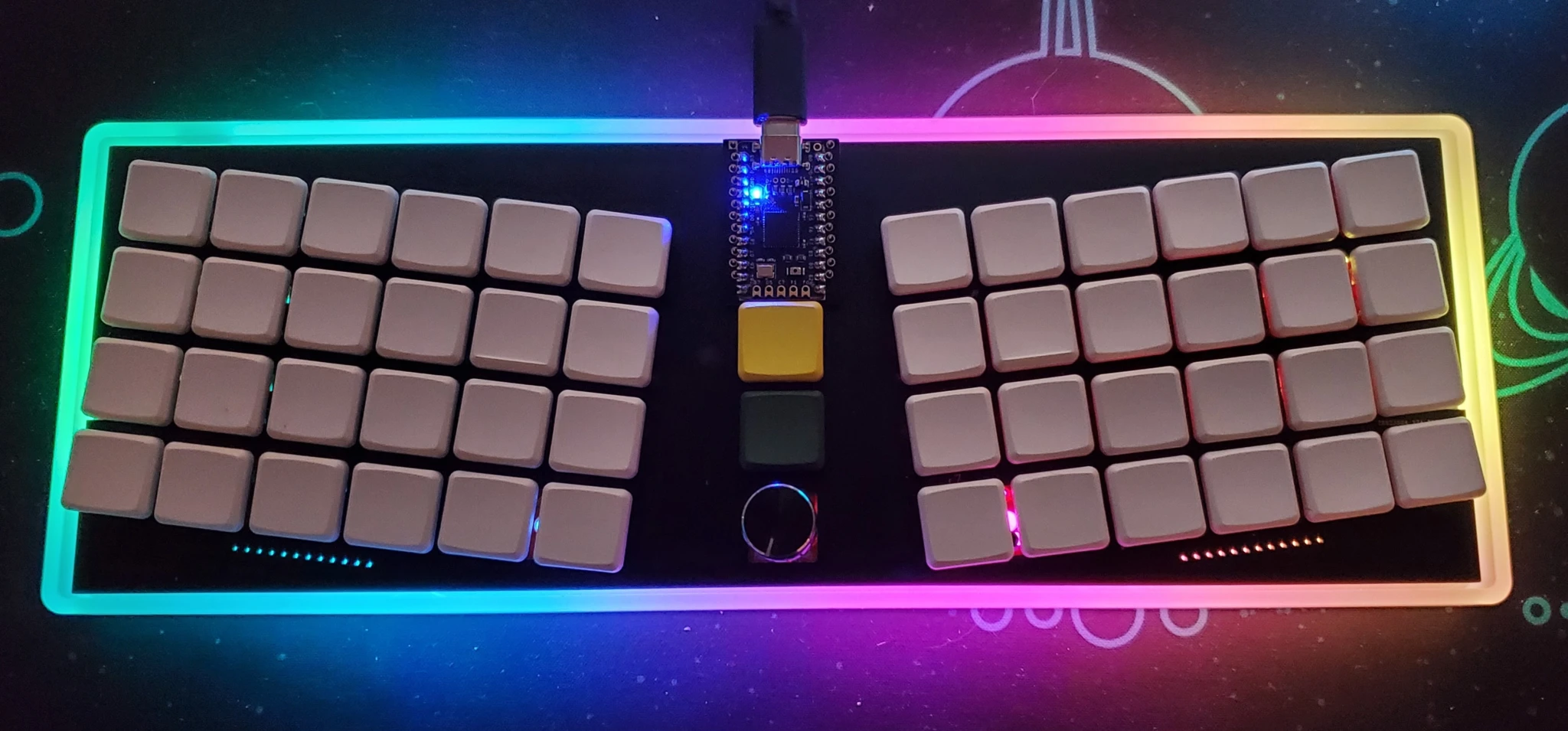
Split Keyboard FAQ
What is a split keyboard?
A split keyboard is divided into two separate halves connected by a cable or wireless link, allowing each hand to rest in a more natural position. This shoulder-width spacing reduces ulnar deviation and strain on the wrists during long typing sessions.
What is the difference between a split keyboard and an ortholinear split keyboard?
All ortholinear split keyboards are split keyboards, but not all split keyboards are ortholinear. An ortholinear split keyboard combines two design ideas: the two halves of a split keyboard plus the grid (non-staggered) column layout of an ortholinear keyboard. Examples include the Corne, Sofle, Lily58, ZSA Voyager, and Dygma Defy.
Are split keyboards better for your wrists?
For most people who type all day, yes. The two halves can be placed shoulder-width apart so your forearms point straight at the keyboard, which reduces ulnar deviation. Adding tenting (angling the inner edges up) further reduces forearm pronation. Studies and most ergonomic guidance recommend split designs for users with existing wrist or RSI concerns.
What is the best split keyboard for beginners?
For a true beginner, the Keychron Q11 ($219) or Q15 Max are the easiest to recommend because they ship fully assembled, support QMK and VIA, and use a familiar Alice-style layout. If you want a true ortho split without DIY, the ZSA Voyager ($365) or Dygma Defy ($369) are the next step. DIY kits like the Corne and Lily58 are more affordable but require soldering or hot-swap socket installation.
What is the best wireless split keyboard in 2026?
The MoErgo Glove80 (concave Dactyl-style, ZMK), Dygma Defy (compact ortho, Bazecor), and Keychron Q15 Max (Alice-style, QMK) are the strongest fully-assembled wireless options. For DIY, a Corne with ZMK firmware on nice!nano controllers gives you wireless on a budget.
Are split keyboards hard to learn?
There's a learning curve of about 1–2 weeks for most typists. The biggest adjustment is column-staggered (ortho) layouts if you choose one; columns no longer offset row-to-row. Standard Alice-style splits like the Keychron Q11 keep the staggered layout and are much faster to adapt to. Most users return to their normal typing speed within a few weeks regardless of which split style they pick.
Still narrowing it down?
Compare the full ortholinear keyboard catalog or read our buyer's guide.
Compare All Ortho KeyboardsRead the Ultimate Guide